

Most Polish entrepreneurs in the UK believe they understand their audience because they know basic demographics like age, location, and income brackets. Yet many still rely solely on basic demographic targeting, despite growing evidence it underperforms in today's privacy-conscious environment. The truth is, effective audience analysis goes far deeper than surface-level data. For Polish business owners navigating the dual-market challenge of serving both diaspora communities and mainstream UK consumers, understanding the motivations, behaviours, and cultural contexts of your audience is the difference between campaigns that convert and budgets that vanish. This guide reveals how to move beyond outdated targeting methods and build a strategic framework that drives genuine brand growth.
Table of Contents
- What is target audience analysis?
- The strategic role of audience analysis for Polish businesses in the UK
- Comparing targeting methods: demographics vs behaviour and context
- Step-by-step guide to conducting target audience analysis
- Common pitfalls and how to avoid them
- Elevate your brand with strategic audience insights
- Frequently asked questions
Key Takeaways
| Point | Details |
|---|---|
| Beyond basics | Effective target audience analysis goes further than age and location, focusing on motivations and cultural context. |
| Cross-cultural advantage | Polish entrepreneurs in the UK succeed by blending diaspora and local insights in their marketing. |
| Better targeting methods | Behavioural and contextual targeting now outperform demographics for privacy and results. |
| Actionable workflow | Follow a step-by-step approach to collect data, segment audiences, and tailor messaging. |
| Avoid common errors | Regularly update your insights and do not rely solely on demographic data to stay relevant and effective. |
What is target audience analysis?
Target audience analysis means systematically identifying, understanding, and segmenting the people most likely to buy or use your brand's services. It's not guesswork or intuition. It's a structured process that combines data, research, and strategic thinking to reveal who your customers are, what drives their decisions, and how to reach them effectively. When you skip this step or treat it superficially, you waste budget on messaging that misses the mark and dilutes your brand impact.
Understanding your audience involves more than just basic demographics. It's about uncovering motivations and context. Effective analysis examines four core elements:
- Demographic insights: Age, location, income, education, and occupation provide the foundation but never the full picture
- Psychographic factors: Values, interests, lifestyle choices, and cultural identity reveal why people make decisions
- Behavioural patterns: Purchase history, online activity, brand interactions, and decision-making processes show how people act
- Contextual signals: The environments, moments, and situations where your audience engages with content or makes buying decisions
Consider the difference between shallow and deep approaches. A shallow analysis might identify your target as "Polish women aged 25-45 in London." A deep analysis reveals they're second-generation Polish-British professionals who value quality, seek brands that respect their heritage, prefer online shopping during evening hours, and make decisions based on peer recommendations rather than traditional advertising. The first approach leads to generic campaigns. The second creates messaging that resonates and converts.
For a comprehensive framework on audience research, explore this Harvard guide on audience analysis that breaks down strategic segmentation methods used by leading brands.
The strategic role of audience analysis for Polish businesses in the UK
Polish entrepreneurs in the UK face a unique dual-market challenge that makes audience analysis not just useful but essential. Your potential customers span a spectrum from recent Polish immigrants who prefer Polish-language content and familiar brands to third-generation British-Poles who identify primarily as British but maintain cultural connections. Mainstream UK consumers represent another segment entirely, with different expectations, buying behaviours, and brand perceptions.
Blending diaspora targeting with UK-localised strategies maximises brand potential and ROI. Audience analysis bridges these cultural gaps by helping you identify which segments to prioritise, how to tailor messaging for each group, and where to allocate resources for maximum impact. Without this strategic foundation, you risk alienating both audiences by trying to be everything to everyone.
Consider a framework for segmenting your bicultural market. Start by mapping your audience across three dimensions: language preference (Polish-dominant, bilingual, English-dominant), cultural identity (strongly Polish, bicultural, primarily British), and buying style (value-focused, quality-focused, convenience-focused). This creates distinct segments with different needs. Polish-dominant, value-focused customers might respond to Polish-language promotions emphasising competitive pricing. Bilingual, quality-focused customers might prefer English content showcasing craftsmanship and heritage. Each segment requires different messaging, channels, and creative approaches.
Pro Tip: Study successful bicultural campaigns from brands like Tymbark or Wedel that have effectively targeted Polish communities in the UK. Analyse how they balance cultural authenticity with local market expectations, then adapt their strategies to your industry and audience.
"Personalisation drives loyalty and higher ROI when tailored for diaspora and local segments. Brands that invest in understanding cultural nuances and behavioural differences consistently outperform competitors who rely on one-size-fits-all approaches."
For deeper insights into strategic audience research, explore upstream demand analysis strategies that help you identify market opportunities before your competitors.
Comparing targeting methods: demographics vs behaviour and context
The targeting landscape has shifted dramatically. What worked five years ago delivers diminishing returns today. Privacy regulations, cookie deprecation, and changing consumer expectations have made traditional demographic targeting less effective whilst elevating behavioural and contextual approaches. Understanding these differences helps you allocate resources wisely and build campaigns that actually perform.

Demographic targeting alone underperforms versus behavioural and context-based approaches in the new privacy landscape. Here's how the three main targeting methods compare:
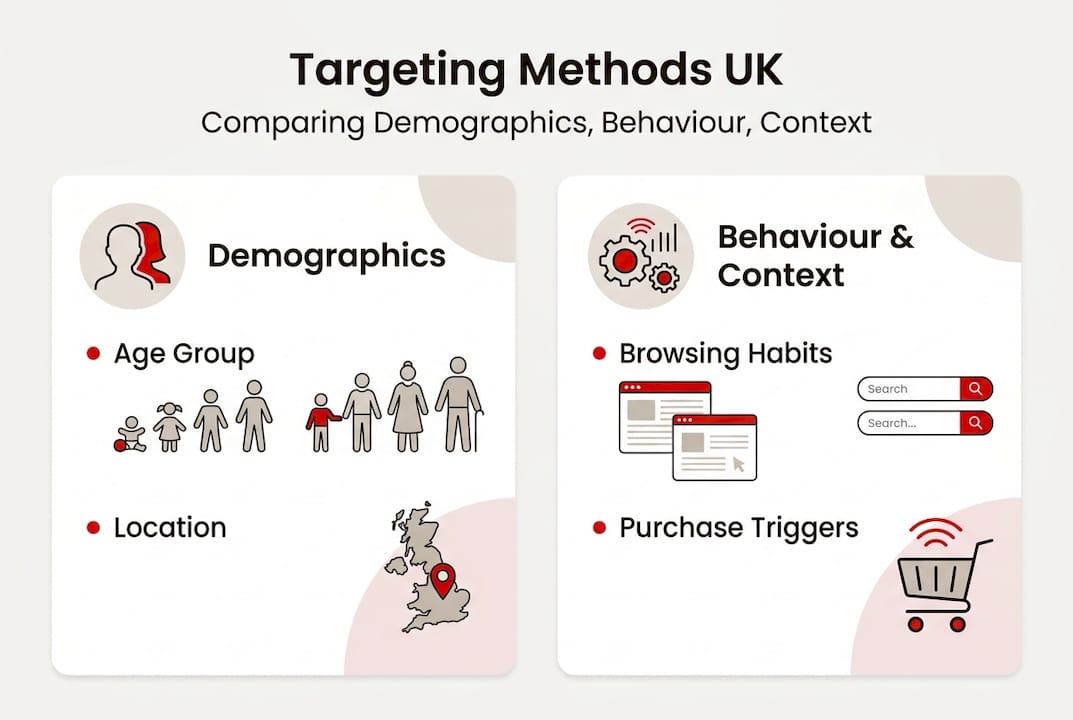
| Targeting Method | Strengths | Limitations | Best Use Cases |
|---|---|---|---|
| Demographic | Easy to implement, widely available data, simple segmentation | Ignores motivations, assumes homogeneity within groups, privacy concerns | Initial market sizing, broad awareness campaigns |
| Behavioural | Reveals actual actions, predicts future behaviour, higher relevance | Requires tracking infrastructure, privacy compliance needed, data interpretation complexity | Retargeting, conversion optimisation, loyalty programmes |
| Contextual | Privacy-friendly, adapts to moment, aligns with user intent | Requires sophisticated content analysis, less precise than behavioural, ongoing optimisation needed | Brand safety, privacy-first campaigns, content marketing |
A UK-based Polish food retailer recently shifted from demographic targeting ("Polish adults 25-55 in Greater London") to contextual targeting based on content consumption patterns. Instead of blanket targeting by nationality, they placed ads within recipe content, Polish cultural articles, and family meal planning resources. Engagement increased by 47%, and cost per acquisition dropped by 32%. The campaign succeeded because it reached people in moments when they were actively thinking about food, regardless of their demographic profile.
Research shows that top brands increase engagement by 30% with behavioural targeting over basic demographic segmentation. The gap widens further when you combine behavioural insights with contextual placement. You're not just reaching the right person but reaching them at the right moment with the right message.
For advanced targeting strategies that combine multiple data sources, explore upstream category meaning and demand landscaping techniques that reveal hidden market opportunities.
Step-by-step guide to conducting target audience analysis
Theory means nothing without execution. Here's a practical workflow you can implement immediately to analyse your audience and apply insights to your marketing strategy. This process works whether you're launching a new brand or refining an established one.
-
Discovery phase: Define your business objectives and identify what you need to learn about your audience. Are you expanding into new segments? Improving conversion rates? Launching a new product? Your goals shape your research focus.
-
Data collection: Gather quantitative and qualitative data from multiple sources. Use website analytics, social media insights, customer surveys, sales data, and competitor analysis. For Polish-UK businesses, include both Polish-language and English-language data sources to capture your full market.
-
Segmentation: Group your audience based on shared characteristics, behaviours, or needs. Avoid creating too many segments (three to five is optimal). Each segment should be substantial enough to justify tailored marketing efforts.
-
Persona development: Create detailed profiles for each segment. Include demographics, but focus heavily on motivations, challenges, goals, and decision-making processes. Give each persona a name and backstory to make them tangible for your team.
-
Testing and validation: Run small-scale campaigns targeting each persona with tailored messaging. Measure response rates, engagement, and conversion. This validates your assumptions and reveals which segments offer the best ROI.
-
Iteration and refinement: Audience analysis is never finished. Review your personas quarterly, update them based on new data, and adjust your strategy as markets evolve and customer behaviours shift.
The most effective marketers now prioritise upstream audience insights and meaning creation over simple campaign execution. Here's a sample segmentation for a Polish-owned UK business:
| Segment Name | Core Characteristics | Primary Needs | Preferred Channels | Key Messaging |
|---|---|---|---|---|
| Polish Expats | Recent immigrants, Polish-language dominant, value-conscious | Familiar brands, competitive pricing, Polish customer service | Polish social media, community groups, Polish shops | Heritage, trust, value |
| Polish-UK Families | Bilingual, bicultural identity, quality-focused | Products that honour heritage whilst fitting UK lifestyle | Facebook, Instagram, family blogs | Quality, authenticity, convenience |
| UK-Born Poles | English-dominant, British identity with Polish roots | Modern brands with subtle cultural connections | Instagram, TikTok, mainstream media | Innovation, style, cultural pride |
| UK Mainstream | No Polish connection, convenience-focused | Quality products, good service, easy purchase process | Google, mainstream social, review sites | Quality, reliability, value proposition |
Pro Tip: Build at least two personas—one for your Polish core audience and one for your UK-localised segment. This forces you to think strategically about how messaging and positioning must differ across cultural contexts. Don't try to serve both with identical campaigns.
Essential tools for audience analysis include customer surveys (Google Forms, Typeform), social media analytics (native platform tools, Hootsuite), CRM systems (HubSpot, Salesforce), and web analytics (Google Analytics, Hotjar). For Polish-UK businesses, consider tools that track multilingual content performance and cross-cultural engagement patterns.
For professional support with market analysis and audience research, explore services for market analysis that combine data science with cultural expertise.
Common pitfalls and how to avoid them
Even experienced marketers make mistakes with audience analysis. Recognising these pitfalls helps you avoid wasting time and budget on strategies that don't work. Here are the most common errors Polish entrepreneurs in the UK should watch for.
Relying only on demographics: Relying solely on demographic data leads to wasted budget and poor campaign performance. Age and location tell you who someone is, not why they buy or how they make decisions. Always layer behavioural and psychographic insights onto demographic foundations.
Assuming Polish audience needs mimic home country: Polish consumers in the UK have different expectations, behaviours, and preferences than those in Poland. They've adapted to UK retail standards, adopted local shopping habits, and developed hybrid cultural identities. Don't simply transplant Polish marketing strategies and expect them to work in the UK context.
Ignoring context and behavioural signals: Where and when someone encounters your brand matters as much as who they are. A Polish professional browsing during lunch break has different needs than the same person shopping on Saturday morning. Context shapes receptivity, so build campaigns that align with audience moments and mindsets.
Failing to adapt strategies for privacy changes: Cookie deprecation, GDPR enforcement, and platform privacy updates have fundamentally changed how you can track and target audiences. Strategies that worked in 2023 may be impossible or ineffective in 2026. Stay current with privacy regulations and shift towards privacy-friendly targeting methods like contextual advertising.
Not updating analysis regularly: Markets evolve, competitors adapt, and customer behaviours shift. Audience analysis from two years ago is outdated. Schedule regular reviews (at minimum every six months) to refresh your understanding and adjust your strategy. This is especially critical for Polish-UK businesses navigating two dynamic markets simultaneously.
Avoid these mistakes by building audience analysis into your regular business rhythm rather than treating it as a one-time project. The brands that consistently outperform competitors are those that maintain current, detailed understanding of their audiences and adapt quickly to changes.
Elevate your brand with strategic audience insights
You've seen how effective audience analysis transforms marketing from guesswork into strategy. For Polish entrepreneurs in the UK, this isn't just about better campaigns. It's about building a brand that resonates across cultures, speaks to real needs, and grows sustainably in competitive markets. The difference between brands that struggle and those that thrive often comes down to how deeply they understand the people they serve.
At Radka Advertising, we specialise in helping cross-cultural brands navigate the complexities of audience analysis and strategic positioning. Our approach combines data-driven insights with cultural expertise to create campaigns that work for both Polish diaspora and mainstream UK audiences. Whether you're refining your targeting strategy, developing new personas, or building a comprehensive brand strategy from the ground up, we bring the tools and experience to accelerate your growth. Explore how our strategic brand development services can help you unlock your brand's full potential in the UK market.
Frequently asked questions
What are the first steps in identifying my target audience in the UK?
Begin with market research to clarify your core customer segments, then segment by cultural background, needs, and buying behaviour. Upstream audience research is now essential for strategic advantage.
Why is demographic targeting less effective now?
Privacy standards and shifting consumer behaviour mean demographics alone miss motivations and context, lowering campaign impact. Behavioural and contextual approaches deliver better results in today's privacy-conscious environment.
How often should I review my audience analysis?
Update your analysis at least every six months to account for changes in market conditions, regulations, and audience behaviour. More frequent reviews are beneficial if you operate in fast-moving sectors or notice significant shifts in campaign performance.
How can I balance Polish and UK-localised marketing?
Develop distinct messaging for both Polish diaspora and UK locals, using cultural insight and targeted campaigns for each segment. Dual-market strategies drive higher loyalty when both local and diaspora audiences are addressed with tailored approaches that respect their unique needs and preferences.
What tools do I need for effective audience analysis?
Start with Google Analytics for web behaviour, native social media analytics for engagement patterns, customer surveys for qualitative insights, and a CRM system to track customer interactions over time. For Polish-UK businesses, consider tools that handle multilingual content and cross-cultural segmentation.