

Brand transformation is a high-stakes endeavour. Failed rebrands can cause 20% sales drop, and 40% fail to deliver positive ROI. Yet when executed strategically, transformation unlocks new markets, revitalises perception, and drives measurable growth. This guide demystifies each stage with proven, actionable steps tailored specifically for Polish-owned businesses navigating the UK digital marketplace. You'll learn when transformation is truly necessary, how to prepare effectively, and the exact process to maximise your investment whilst avoiding costly pitfalls.
Table of Contents
- When should you consider a brand transformation?
- Preparing for a successful transformation: audit and strategy
- Tools, team and timelines for a smooth brand evolution
- Step-by-step: the brand transformation process
- Biggest pitfalls and how to avoid them
- Measuring your brand transformation's impact
- Expert brand transformation support for Polish businesses in the UK
- Frequently asked questions
Key Takeaways
| Point | Details |
|---|---|
| Careful preparation | Most rebrand failures are due to skipping audits and strategy. |
| Step-by-step execution | Sequencing each phase—assessment, strategy, rollout—prevents costly disruption. |
| Avoid digital pitfalls | Neglecting SEO and asset migration is a leading cause of lost business. |
| Measure and improve | Tracking KPIs and feedback ensures your transformation delivers real results. |
When should you consider a brand transformation?
Before committing resources, determine whether transformation is genuinely necessary. Rebranding is only recommended for pivots, mergers, or reputation resets because cost and ROI considerations often mean the answer should be no. Transformation makes strategic sense in specific circumstances: company mergers requiring unified identity, radical business model pivots, major reputation crises, or entering entirely new markets.
Understand the distinction between brand refresh and full transformation. A refresh updates visual elements and messaging whilst preserving existing brand equity—lower risk, lower cost, and often sufficient for businesses with strong foundations. Full transformation rebuilds identity from the ground, appropriate only when fundamental change is unavoidable.
The risks of unnecessary transformation include:
- Significant financial investment with uncertain returns
- Confusing loyal customers who recognise your current identity
- Losing hard-earned brand equity and market position
- Diverting resources from revenue-generating activities
"Most businesses benefit more from refining their existing brand than starting over. Transformation should solve a specific, measurable problem."
Before proceeding, explore the phases in successful brand transformation to ensure your situation genuinely warrants this level of change.
Preparing for a successful transformation: audit and strategy
Once you've confirmed transformation is essential, rigorous preparation dramatically improves outcomes. Skipping the foundational audit makes brands 3.5x more likely to fail, and this critical phase typically requires 4-6 weeks.
Begin with an honest brand audit examining current perception, market visibility, and existing assets. Document how customers, competitors, and the broader UK market view your business. Identify gaps between your intended positioning and actual perception.
Research your UK audience and competitors thoroughly. Polish entrepreneurs must understand digital behaviours specific to British consumers, cultural nuances affecting purchasing decisions, and competitive positioning within your sector. Analyse how similar businesses communicate, their visual identity patterns, and gaps you can exploit.
Define your core values, vision, and unique selling points with precision. What makes your business irreplaceable? How do you want customers to feel when they encounter your brand? These foundational elements guide every subsequent decision.
Set clear business objectives and ROI metrics before design begins. Transformation without measurable goals becomes an expensive creative exercise. Establish baseline metrics for brand awareness, customer acquisition cost, conversion rates, and customer lifetime value.
Pro Tip: Use an audit template and involve your core team for honest feedback. Internal perspectives often reveal blind spots that external consultants miss, and team buy-in proves essential for successful implementation.
| Audit component | Key questions | Timeline |
|---|---|---|
| Brand perception | How do customers describe us? What emotions does our brand evoke? | 1-2 weeks |
| Market position | Where do we rank against competitors? What's our unique value? | 1-2 weeks |
| Asset inventory | What visual and written materials exist? What needs updating? | 1 week |
| Digital presence | How do we perform in search, social, and online reviews? | 1 week |
Examine measurable results from marketing-centric brand changes to understand realistic outcomes. For additional guidance, consult this strategy audit checklist covering essential preparation steps.
Tools, team and timelines for a smooth brand evolution
Proper resourcing determines whether your transformation succeeds or stalls. Average rebrand takes 7 months, covers 215 assets, with small business timelines typically spanning 3-6 months and larger transformations requiring 6-12 months.
Assemble a team with these essential roles:
- Brand manager or business owner providing strategic direction
- Designer creating visual identity and asset templates
- Copywriter developing messaging and tone guidelines
- Digital marketer managing online presence and SEO migration
- Legal and compliance specialist handling trademark and regulatory requirements
Essential tools streamline execution and maintain consistency:
| Tool category | Purpose | Examples |
|---|---|---|
| Brand guidelines | Document visual standards, tone, usage rules | Frontify, Brandfolder |
| Asset management | Centralise logos, images, templates | Bynder, Brandfolder |
| SEO migration | Preserve rankings during domain or URL changes | Screaming Frog, Google Search Console |
| Analytics | Track performance before, during, and after launch | Google Analytics, social media insights |
Create a comprehensive asset inventory logging every logo variation, social media handle, legal document, marketing material, and digital property. This prevents overlooked elements that create inconsistent brand experiences. Explore brand management tools designed to simplify this process.

Step-by-step: the brand transformation process
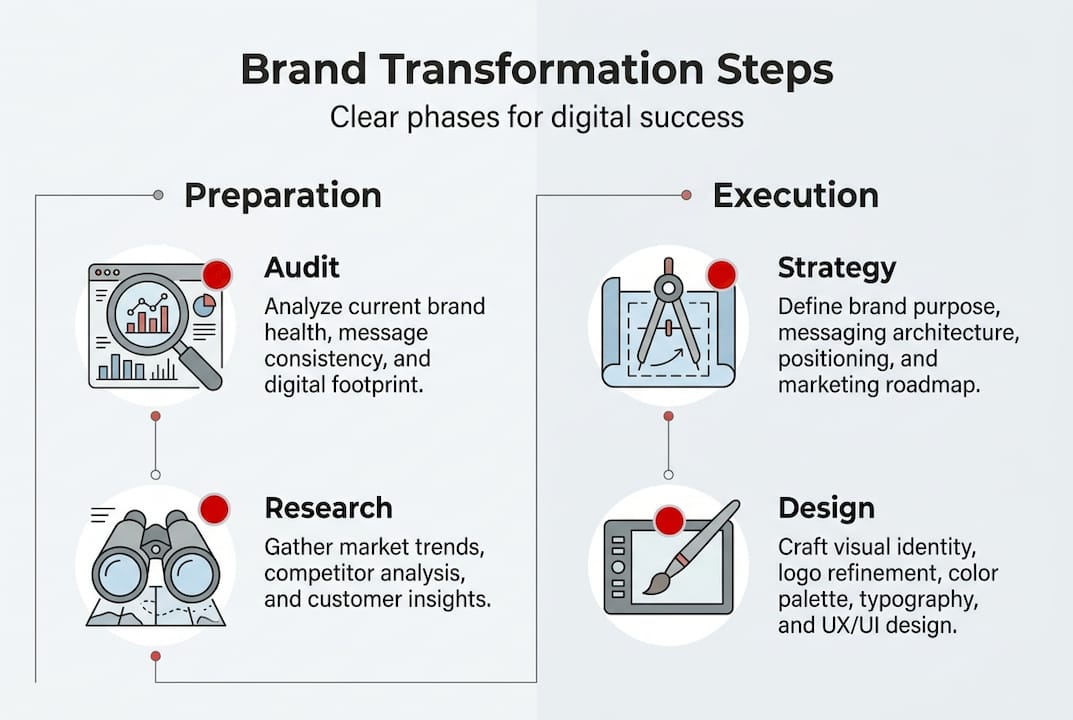
With your team and resources aligned, execute your transformation through these sequential phases:
-
Internal brand audit: Document current positioning, perception gaps, and asset inventory as detailed in the preparation section.
-
Audience and competitor analysis: Research UK market behaviours, cultural considerations for Polish entrepreneurs, and competitive landscape to identify differentiation opportunities.
-
Strategy formulation: Define core values, vision, positioning, and messaging framework. Establish success metrics and ROI targets before any design work begins.
-
Design and messaging: Develop visual identity, logo variations, colour palette, typography, and tone guidelines. Create templates for consistent application across channels.
-
Legal, digital and SEO migration: Register trademarks, update business registrations, implement 301 redirects, update Google Business Profile, and migrate social media handles whilst preserving followers and engagement.
-
Launch planning and asset rollout: Choose between traditional simultaneous launch or phased digital-first approach.
| Rollout approach | Advantages | Considerations |
|---|---|---|
| Traditional (simultaneous) | Creates immediate impact, clear before/after distinction | Higher risk if issues emerge, requires extensive coordination |
| Digital-first (phased) | Test and refine before full commitment, lower risk | May confuse customers during transition, requires clear communication |
- Measurement and refinement: Track KPIs weekly for the first month, monthly thereafter. Adjust messaging, visuals, or strategy based on customer response and performance data.
Pro Tip: Start with assessment, audience understanding, then strategy and design to avoid costly revisions. Many businesses rush to visuals without strategic foundation, resulting in beautiful brands that fail to connect with target audiences.
Study real-world transformation success to understand practical application. Nike's digital-first strategy demonstrates how phased rollouts can test market response whilst minimising risk.
Biggest pitfalls and how to avoid them
Even well-planned transformations encounter obstacles. Understanding common failures helps you navigate successfully.
Rushing the audit, neglecting strategy, missing SEO migration and internal alignment rank as top failure factors. Specifically:
-
Failing to complete thorough audit: Brands skipping this step are 3.5x more likely to fail because they lack baseline understanding of current perception and market position.
-
No clear strategy before visuals: 70% of transformations fail when design precedes strategy. Beautiful logos cannot compensate for unclear positioning or messaging that misses target audiences.
-
Forgetting SEO redirects: Missing 301 redirects during domain or URL changes destroys search rankings, loses organic traffic, and confuses existing customers trying to find you online.
-
Overlooking employee buy-in: Internal teams represent your brand daily. Without their understanding and enthusiasm, inconsistent customer experiences undermine transformation efforts.
-
Confusing refresh with transformation: Choosing the wrong approach wastes resources. Refresh when foundations are strong; transform only when fundamental change is necessary.
"The most expensive mistake is treating transformation as purely visual. Strategy, migration, and measurement determine success far more than logo design."
Pro Tip: Use detailed checklists and involve a digital expert for technical migration. Small oversights in redirects, metadata, or social media handles create disproportionate damage to your investment.
Learn from lessons from failed and successful projects to avoid repeating common mistakes.
Measuring your brand transformation's impact
Consistent measurement ensures your transformation delivers genuine growth rather than expensive cosmetic change.
Measure transformation success via KPIs like engagement, conversions, with successful rebrands seeing significant positive ROI. Establish these measurement practices:
-
Identify clear KPIs before launch: Track brand awareness (social mentions, search volume), engagement (website time, social interactions), conversions (leads, sales), search rankings, and customer retention rates.
-
Document before-and-after numbers: Baseline metrics from your audit phase provide comparison points. Monitor weekly initially to spot negative trends early, then monthly once patterns stabilise.
-
Gather UK customer feedback: Reviews, social media mentions, and direct customer conversations reveal perception shifts that quantitative data misses. Polish business owners should pay particular attention to cultural reception within British markets.
-
Iterate based on data: Transformation isn't finished at launch. Refine messaging, adjust visual applications, and sharpen strategy continuously based on performance insights.
Successful transformations typically show measurable improvement within 3-6 months: increased website traffic, higher conversion rates, improved customer sentiment, and stronger competitive positioning. Track these indicators against your pre-transformation baseline to calculate genuine ROI.
Monitor tracking KPIs after transformation using centralised dashboards that consolidate data from multiple sources for comprehensive performance visibility.
Expert brand transformation support for Polish businesses in the UK
Navigating brand transformation requires strategic expertise, creative excellence, and technical precision. Polish entrepreneurs in the UK face unique challenges: balancing cultural identity with British market expectations, establishing credibility in competitive sectors, and maximising limited marketing budgets.
Radka Advertising specialises in guiding Polish-owned businesses through successful digital brand evolution. Our full-service approach combines strategic consulting, distinctive design, technical SEO migration, and comprehensive asset rollout. We understand the nuances of positioning Polish businesses for UK audiences whilst preserving authentic brand values.
Our bespoke process ensures your transformation delivers measurable ROI rather than expensive uncertainty. From initial audit through post-launch refinement, we handle technical complexities whilst you focus on running your business. Explore our expert brand transformation support to understand our strategic approach, review our brand transformation services for detailed offerings, and examine brand transformation results showcasing proven outcomes across diverse industries. Your brand's next chapter deserves experienced partnership.
Frequently asked questions
How long does a typical brand transformation take?
Most brand transformations take about 3-7 months for small businesses, depending on scope and asset inventory. Larger organisations may require 6-12 months for comprehensive transformation.
Can I refresh my brand instead of a full transformation?
Yes—brand refresh preserves equity and is lower risk than full transformation. If there's no major market shift or reputation crisis, refreshing visuals and messaging whilst maintaining core identity often delivers better ROI.
What are the top mistakes to avoid in brand transformation?
Brands skipping audit 3.5x more likely to fail, and SEO migration is critical. Major mistakes include rushing the audit phase, ignoring digital and SEO migration, launching without clear strategy, and failing to track post-launch performance.
How will a strong brand transformation affect my bottom line?
A successful transformation boosts sales, customer acquisition, and brand perception. However, failed rebrands can cause a 20% drop in sales, making strategic planning and expert execution essential for positive ROI.